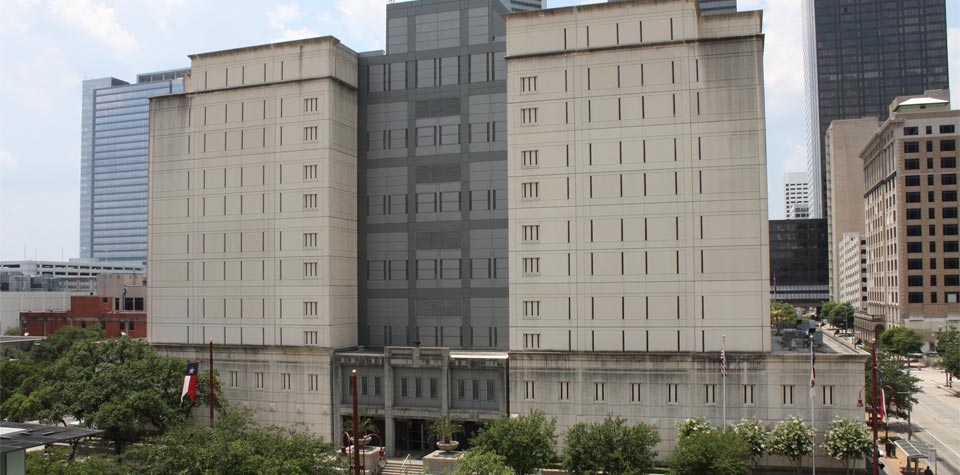
Federal Detention Center Houston
Federal Prison | Harris County — Texas | FDC Houston
Federal Detention Center Houston (FDC Houston) is a multi-security level federal detention facility located at 1200 Texas Avenue in the heart of downtown Houston, Harris County, Texas. Operated by the Federal Bureau of Prisons (BOP), the facility opened in 1999 and was designed to hold up to 872 male inmates, though it currently houses approximately 905 detainees across minimum through maximum security classifications. Under the leadership of Warden Joe D. Driver, FDC Houston plays a central role in the federal justice system of the Southern District of Texas, serving as the primary detention point for pretrial federal detainees and short-term sentenced inmates awaiting transfer or court proceedings.
The facility's downtown location is no accident — it was specifically sited to reduce the logistical burden of transporting detainees to and from the nearby federal courthouse, minimizing both cost and security risk. FDC Houston is one of the more strategically important federal detention facilities in the region, handling a high volume of cases that include immigration violations, drug trafficking, fraud, and other federal offenses. It is one of many federal and state facilities listed among Texas correctional facilities on our directory.
For families of people held at FDC Houston, navigating the system can feel overwhelming. This page provides comprehensive information on visitation, inmate communication, sending money, and locating a loved one. Families can also search criminal records to find current incarceration status and case information through public records tools. If you are unsure where to begin, our guide on how to find an inmate walks you through the process step by step.
What sets Federal Detention Center Houston apart from most federal correctional facilities in the country is its remarkable urban footprint. Situated at 1200 Texas Avenue in Houston's central business district, FDC Houston is one of relatively few federal detention centers in the United States that operates entirely within a major metropolitan downtown core. Rather than the expansive grounds typically associated with federal prisons, the facility functions within the physical and spatial constraints of a high-density urban environment — a vertical, self-contained structure that must balance security requirements with the realities of city living.
This urban positioning creates a unique operational dynamic. Detainees at FDC Houston are within a short distance of the federal courthouse, making it possible to move individuals to court appearances with far greater efficiency than facilities located on the outskirts of the city. This proximity is particularly significant given the volume of pretrial detainees housed at the facility at any given time — many of whom may have multiple court appearances over the course of their cases.
The facility's location in Houston also reflects the city's role as a major hub for federal prosecutions in the Southern District of Texas, one of the busiest federal judicial districts in the nation. Cases involving international drug trafficking, human smuggling, financial fraud, and immigration violations frequently funnel through this district, and FDC Houston serves as the primary holding point for many of those defendants. The combination of urban architecture, high case volume, and courthouse proximity makes FDC Houston genuinely distinctive among federal detention facilities nationwide.
Federal Detention Center Houston currently holds approximately 905 male inmates, a figure that exceeds the facility's designed capacity of 872. The population is exclusively male and spans multiple security classifications, from minimum to maximum security, with housing assignments determined by each inmate's risk assessment, legal status, and behavior history.
The largest segment of the population consists of pretrial detainees — individuals who have been charged with federal crimes but have not yet been convicted or sentenced. These detainees are awaiting hearings, trials, or plea proceedings in the United States District Court for the Southern District of Texas. A smaller portion of the population consists of sentenced federal inmates serving shorter terms or waiting for designation and transfer to a permanent Bureau of Prisons facility.
The offense categories represented at FDC Houston reflect the Southern District's prosecutorial priorities. Drug trafficking cases — many involving defendants connected to Mexican cartels or Houston-based distribution networks — make up a substantial portion of the population. Immigration-related offenses, federal firearms violations, financial crimes, and fraud cases are also well represented. The facility's population is notably diverse, reflecting Houston's status as one of the most ethnically and linguistically varied cities in the United States. A significant number of detainees are Spanish-speaking, which has shaped the facility's staffing, programming, and communication resources over the years.
Life inside Federal Detention Center Houston is shaped largely by the facility's urban, high-capacity design. Inmates are housed in units organized according to security classification and legal status, with pretrial detainees and sentenced inmates kept in separate housing as required by federal regulations. Depending on their classification, inmates may be housed in individual cells or in dormitory-style arrangements. Cells are compact by design, a reflection of the facility's vertical, urban architecture rather than a traditional sprawling prison campus.
Meals are served three times daily and are prepared in accordance with Bureau of Prisons nutritional guidelines. The facility accommodates religious dietary requirements, including halal and kosher options, for inmates with documented religious needs. Access to medical care is provided through the facility's health services unit, which handles routine medical needs, mental health services, and dental care. Serious medical conditions may require outside referrals to approved providers.
Recreation is available through both indoor and outdoor areas, though the urban setting does impose some limitations on the scale of outdoor space compared to rural federal facilities. Inmates have access to a law library for legal research, which is particularly important given the large pretrial population who may be actively working on their own cases. Commissary services allow inmates to purchase supplemental food items, hygiene products, and other approved goods. Television and limited reading materials are available in common areas, and inmates may purchase personal radios or MP3 players through the commissary in accordance with BOP policy.
Despite its primary function as a detention facility for pretrial inmates, Federal Detention Center Houston offers a meaningful range of programs designed to address educational, vocational, and rehabilitative needs during incarceration. The Bureau of Prisons requires that facilities provide certain core programming regardless of the pretrial or sentenced status of the population, and FDC Houston has developed offerings that reflect both federal mandates and the specific demographics of its detainee population.
Educational programming includes GED preparation and adult literacy classes for inmates who have not completed a high school diploma. Given the high proportion of Spanish-speaking detainees, English as a Second Language (ESL) courses are a particularly prominent offering and serve a large segment of the population. These classes are taught by facility education staff and, in some cases, credentialed volunteers from the community.
Substance abuse programming is available through both residential and non-residential formats. The facility's drug education and counseling services help inmates begin to address addiction issues that may have contributed to their offense conduct. While the full Residential Drug Abuse Program (RDAP) is more commonly available at designated federal prisons, FDC Houston offers initial assessment and non-residential counseling as part of the BOP's broader continuum of care.
Religious and faith-based programming is robust, with chaplaincy services accommodating a wide range of faith traditions including Christianity, Islam, Judaism, and others. Worship services, religious study groups, and pastoral counseling are available on a regular basis. Volunteers from Houston's faith community frequently participate in programming. Life skills courses, parenting classes, and cognitive behavioral programming are also offered, helping inmates develop practical tools for reentry even during periods of pretrial detention.
Work assignments at Federal Detention Center Houston include essential facility operations such as food service, laundry, janitorial duties, and maintenance positions that keep the institution functioning. Inmates may work in the commissary, law library, or performing clerical tasks supporting administrative operations. Given the facility's urban location and detention mission, extensive industrial operations or outside work details are limited compared to traditional federal correctional institutions. Work assignments provide inmates with productive activity, modest compensation deposited into their commissary accounts, and structure to their daily routines. Participation in work programs may be considered favorably for sentenced inmates, though pretrial detainees face restrictions on certain assignments pending resolution of their cases.
Federal Detention Center Houston opened its doors in 1999, constructed in direct response to the rapidly growing demand for federal detention space in the Southern District of Texas. During the 1990s, Houston experienced significant population growth alongside a dramatic increase in federal criminal caseloads — particularly those tied to drug trafficking, immigration enforcement, and organized crime operating through one of the nation's busiest port cities. The Bureau of Prisons recognized that existing facilities in the region were insufficient to meet this demand and commissioned the construction of a purpose-built urban detention center.
The decision to place the facility in downtown Houston was deliberate and practical. Proximity to the Bob Casey United States Courthouse on Rusk Street meant that pretrial detainees could be transported to hearings quickly and securely, reducing the operational costs and safety risks associated with moving inmates across long distances. The building was designed from the ground up to function as a modern, multi-security urban detention center — a departure from the sprawling rural campus model that had characterized federal prison construction for much of the twentieth century.
Since its opening, FDC Houston has processed tens of thousands of federal detainees, many of them connected to some of the most significant drug trafficking prosecutions in the Gulf Coast region. The facility gained particular relevance as federal law enforcement intensified its focus on cartel-connected smuggling networks moving narcotics and people through Houston's port infrastructure. Over the decades, the Bureau of Prisons has updated the facility's programs, technology, and security protocols to keep pace with the evolving demands of federal detention. Today, FDC Houston remains one of the busiest and most important federal detention facilities in Texas.
Federal Detention Center Houston has housed a large number of defendants over the years, many of them involved in significant federal prosecutions across the Southern District of Texas. However, the facility does not have a widely documented roster of nationally famous former inmates, largely because most high-profile detainees pass through on a temporary basis before being transferred to permanent BOP facilities following sentencing.
One notable case associated with FDC Houston is that of Joel Lopez, whose conduct while detained at the facility drew significant attention from the federal judiciary and law enforcement community. Lopez had been sentenced to life in federal prison on drug trafficking charges. While incarcerated, he allegedly approached a fellow inmate and solicited the murder of U.S. District Judge Ricardo Hinojosa, the judge who had presided over his sentencing. The plot was uncovered before any harm occurred, and Lopez was subsequently convicted of conspiracy to commit murder, adding further charges to an already severe sentence. The case served as a stark reminder of the security challenges faced by federal detention facilities and the lengths to which some inmates will go to retaliate against the justice system. You can search criminal records to find publicly available case information on individuals who have been processed through FDC Houston.
Visiting a loved one at Federal Detention Center Houston requires advance planning and adherence to the Bureau of Prisons' visitor approval process. Before a visit can take place, prospective visitors must submit a visitor application, which is reviewed and approved by facility staff. This background check process is standard across all BOP facilities and is designed to maintain the safety and security of the institution. Approval is not guaranteed and may be denied based on criminal history or other factors.
Once approved, visitors must schedule their visits in advance. Walk-in visits are not permitted. All visitors aged 16 and older must present a valid, government-issued photo identification at the time of the visit — acceptable forms include a driver's license, state ID, or passport. Visitors under 16 must be accompanied by an approved adult visitor.
The facility enforces a strict dress code. Visitors should avoid wearing clothing that is revealing, resembles staff or law enforcement uniforms, or features colors and patterns that are restricted within the institution. It is strongly recommended that visitors confirm current dress code requirements directly with the facility before traveling, as policies can be updated. Visitors who arrive out of compliance may be turned away.
Visits take place in a designated visiting room under staff supervision. Physical contact is typically limited to a brief greeting and farewell. Visitors may bring a limited amount of cash for vending machines, but large bags, cell phones, and most personal items must be left in a vehicle or secured locker. Children must be supervised at all times. For official visiting rules and to confirm current scheduling procedures, visit the Bureau of Prisons visitation information page. In addition to in-person visits, families can support incarcerated loved ones by finding ways to send money to an inmate for use in the commissary.
Maintaining contact with a loved one at Federal Detention Center Houston is an important part of supporting them through the incarceration process. The facility accommodates several forms of communication, including physical mail, telephone calls, and electronic messaging through approved platforms.
Mailing Address: All physical mail sent to inmates must be addressed using the inmate's full legal name and their eight-digit BOP register number. Use the following format:
- Inmate Full Legal Name, Register Number
- FDC Houston Federal Detention Center
- P.O. Box 526255
- Houston, TX 77052
All incoming mail is opened and inspected by facility staff for contraband and content that violates BOP regulations. Envelopes must be plain white with no decorative designs on the interior. Books and magazines must be shipped directly from a publisher or approved retailer such as Amazon — packages sent from home are not permitted. Photographs are generally allowed but must comply with size and content restrictions.
Phone Calls: Inmates at FDC Houston may make outgoing phone calls through the BOP's contracted telephone service provider. Calls are monitored and recorded unless they are designated as privileged attorney-client communications. Families must ensure their phone number is on the inmate's approved call list. Rates and account management are handled through the phone service provider's website or customer service line.
Electronic Messaging: The Bureau of Prisons offers an electronic messaging service through its TRULINCS system, which allows inmates to send and receive email-style messages with approved contacts. Families must set up an account and add funds to communicate electronically. Messages are subject to monitoring.
To locate a specific individual within the federal system, the BOP Inmate Locator is the most reliable official tool. You can also look up an inmate's arrest history and case details using public records searches. For additional guidance, see our full resource on how to find an inmate in the federal system.
Sponsored and Powered by our Partner TruthFinder
Quick Facts
Should I Be Concerned? — Family Guide
Federal Detention Center Houston maintains rigorous safety standards with an excellent security track record and zero reported staff assaults in recent years. The facility employs a multi-level custody classification system that properly segregates inmates by security risk, significantly reducing potential conflicts and safety concerns. Despite operating at elevated capacity levels, comprehensive security protocols and professional staff management ensure controlled operations and visitor safety.
For families visiting detained loved ones, the facility's structured visiting procedures and security screening processes provide a secure environment. The professional staff conducts thorough background checks and maintains strict visitation protocols. Visitors should expect standard security procedures including identification verification and bag screening. All visits are supervised and monitored to ensure the safety of visitors, staff, and inmates.
Neighborhood & Getting There
Federal Detention Center Houston is strategically located at 1200 Texas Avenue in downtown Houston's Legal District, adjacent to the Sam Houston Federal Courthouse and minutes from Harris County's civic center. The facility sits at the convergence of major transportation corridors including I-45 and I-10, making it accessible from throughout the Greater Houston metropolitan area. Most visitors can reach the facility within 15-30 minutes depending on traffic patterns and origin location.
The surrounding downtown area offers abundant visitor services including hotels such as the Hilton Houston Downtown, Lancaster Hotel, and Marriott Marquis within walking distance or a short drive. Numerous restaurants, cafes, and parking facilities serve the legal district. Street parking and nearby parking garages provide convenient options for visitors. The downtown location means easy access to public transportation, including METRO bus lines connecting to regional transit hubs.