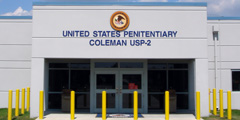
United States Penitentiary Coleman II
Federal Prison | Sumter County — Florida | USPC II | Federal Bureau of Prisons
United States Penitentiary Coleman II is a maximum security federal prison located at 846 NE 54th Terrace in Wildwood, Sumter County, Florida. Operating under the Federal Bureau of Prisons rather than the Florida Department of Corrections, this facility houses 1,438 male inmates convicted of serious federal offenses. The institution is managed by Warden Charles Lockett and serves as one component of the larger Federal Correctional Complex Coleman, one of the nation's most extensive federal prison campuses.
Families seeking information about inmates at USP Coleman II can use JailData.com to search inmate records and access arrest information. Our resources help you understand how to send money, schedule visits, and maintain communication with your incarcerated loved one. We provide essential guidance for navigating the federal prison system and staying connected throughout the incarceration period.
United States Penitentiary Coleman II distinguishes itself as part of the Federal Correctional Complex Coleman, one of the largest federal prison complexes in the United States. Unlike state facilities, USP Coleman II operates under federal jurisdiction and houses inmates convicted of federal crimes rather than state offenses. The Coleman complex encompasses multiple security-level facilities across thousands of acres in central Florida, creating a comprehensive federal incarceration hub. USP Coleman II specifically handles maximum security inmates requiring the highest custody levels within the federal system. This facility's integration within the broader Coleman complex allows for specialized resources and coordinated operations unique among Florida's correctional landscape.
USP Coleman II houses 1,438 male inmates classified at the maximum security level within the federal prison system. The population consists entirely of sentenced federal offenders who have been convicted of serious crimes including violent offenses, organized crime activities, drug trafficking conspiracies, weapons violations, and white-collar crimes carrying lengthy sentences. Unlike county jails, this facility does not hold pre-trial detainees or individuals awaiting sentencing. Many inmates serve extended sentences and may have significant criminal histories or disciplinary infractions from lower-security institutions. The population may include inmates requiring protective custody, those with gang affiliations requiring separation, and individuals serving mandatory minimum sentences under federal guidelines. All residents have been classified as requiring maximum security supervision based on their offense severity, institutional behavior, or other security considerations.
Inmates at USP Coleman II reside in secure housing units designed for maximum security confinement. Living arrangements typically include single or double-occupancy cells with controlled movement throughout the facility. Inmates receive three meals daily prepared in accordance with federal nutrition standards, with accommodations for religious dietary requirements and medical restrictions. Recreation opportunities exist but occur under strict supervision with limited access compared to lower-security facilities. The institution provides medical services through on-site healthcare staff who address routine medical needs, chronic conditions, and emergency care, with serious cases transferred to outside facilities. Mental health services are available through psychology staff who provide counseling, crisis intervention, and psychiatric care. Inmates experiencing issues with conditions, staff conduct, or other concerns can file grievances through the formal Bureau of Prisons Administrative Remedy Program, which allows appeals through multiple levels if initial responses prove unsatisfactory.
USP Coleman II offers educational programs including GED preparation and post-secondary correspondence courses for inmates seeking to advance their education during incarceration. Vocational training opportunities may be limited compared to lower-security institutions but can include skills development in areas compatible with maximum security operations. The facility provides substance abuse treatment programs through the Bureau of Prisons' drug abuse education and treatment initiatives, addressing addiction issues that contributed to many federal offenses. Religious services accommodate multiple faith traditions with chaplaincy staff coordinating worship opportunities, religious counseling, and spiritual guidance. Re-entry programming helps inmates prepare for eventual release through courses addressing life skills, employment readiness, and community reintegration. Program participation depends on individual security classification, sentence length, and institutional conduct, with maximum security restrictions limiting access compared to medium or low-security facilities.
Work assignments at USP Coleman II include institutional maintenance positions that keep the facility operational. Inmates may work in food service preparing and serving meals, performing janitorial duties maintaining housing units and common areas, or handling laundry operations. Some positions exist in facility grounds maintenance within secure perimeters. Additional work opportunities include assignments supporting administrative functions under close supervision. Unlike minimum security camps, outside work details and community-based assignments are not available due to the maximum security classification. Federal Prison Industries (UNICOR) may operate at the Coleman complex, potentially offering manufacturing work opportunities depending on security clearance and institutional needs. These work assignments provide modest compensation while teaching job skills and work discipline.
United States Penitentiary Coleman II was established as part of the Federal Bureau of Prisons' expansion to address growing federal inmate populations during the tough-on-crime era. The facility opened as one component of the Federal Correctional Complex Coleman, which developed into one of the nation's largest federal prison campuses. Construction of the Coleman complex represented a significant federal investment in correctional infrastructure in central Florida, chosen for its accessibility and available land. The complex grew to include multiple facilities at varying security levels, with USP Coleman II serving the maximum security population. Throughout its operational history, the institution has housed thousands of federal inmates convicted of serious offenses under federal law. The facility continues its role as a critical component of the federal prison system, managing long-term maximum security inmates under Bureau of Prisons standards and protocols.
Visitation at USP Coleman II requires advance approval through the Bureau of Prisons' visitor application process. Prospective visitors must complete forms and undergo background checks before placement on an inmate's approved visiting list. All visitors must present valid government-issued photo identification upon arrival. The facility enforces strict dress code regulations prohibiting revealing clothing, certain colors, and items that resemble inmate uniforms. Visitation typically occurs on scheduled days and times determined by the inmate's housing unit assignment. Visitors should expect security screening including metal detectors and possible pat-down searches. Contact visits may be limited based on inmate custody level and behavior. Families should call the facility well in advance to confirm current visitation schedules, procedures, and any temporary restrictions before traveling to Wildwood.
Mail sent to inmates at USP Coleman II must include the inmate's full legal name and register number, addressed to United States Penitentiary Coleman II, P.O. Box 1034, Coleman, FL 33521. All incoming correspondence undergoes inspection before delivery to inmates. Books, magazines, and newspapers must come directly from approved vendors or publishers rather than individuals. Inmates can make outgoing phone calls using the facility's phone system after contacts establish prepaid accounts through the Bureau of Prisons' approved telephone service provider. Some limited email services may be available through the TRULINCS system, allowing electronic messaging with approved contacts for a fee. Families should confirm current communication policies and account setup procedures directly with the facility.
Sponsored and Powered by our Partner TruthFinder
Quick Facts
Should I Be Concerned? — Family Guide
United States Penitentiary Coleman II maintains a maximum security environment with zero reported staff assaults, indicating effective safety management. The facility employs rigorous security measures standard for federal penitentiaries. Visitors should expect thorough security screening, strict identification requirements, and adherence to all facility rules during visits.
Neighborhood & Getting There
United States Penitentiary Coleman II is located in Wildwood, a rural area in Sumter County, approximately 75 miles northwest of Orlando and 120 miles north of Tampa. The facility sits in central Florida's sparsely populated region. Sumterville offers basic services; travelers typically access lodging and dining in nearby Ocala (30 miles south) or Leesburg (25 miles east). US Highway 27 and US Highway 301 provide primary vehicle access to the facility.