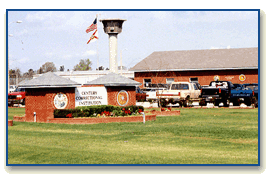
Century Correctional Institution
State Prison | Escambia County — Florida | Century C.I. | Florida Department of Corrections (FL DOC)
Century Correctional Institution is a Level 5 maximum security facility located at 400 Tedder Road in Century, Escambia County, Florida. Opened in 1991, this Florida Department of Corrections institution houses adult male offenders and currently holds 1,373 inmates, operating slightly above its designated capacity of 1,345. Under the leadership of Warden Randall Bryant, the facility manages some of Florida's most serious offenders requiring the highest level of custody and supervision.
Families seeking information about inmates at Century Correctional Institution can use our inmate search tools to locate loved ones, view arrest records, and access important facility details. Our resources help you understand how to send money, schedule visits, and maintain communication with inmates housed at this northwest Florida correctional facility.
Century Correctional Institution serves as one of Florida's critical maximum security facilities specifically designed to house the state's most dangerous and high-risk male offenders. Located in the rural panhandle region of Escambia County, the facility's remote position in Century provides geographical separation while maintaining security protocols essential for Level 5 operations. The institution operates above capacity, reflecting Florida's ongoing challenges with prison population management. Its strategic location near the Alabama border allows it to serve the northwestern portion of Florida's correctional system while maintaining the intensive security measures necessary for maximum custody inmates who require constant supervision and controlled movement throughout the facility.
Century Correctional Institution exclusively houses adult male inmates classified at Level 5, representing the highest security designation within the Florida Department of Corrections system. The population consists primarily of convicted felons serving lengthy sentences for violent crimes, those with extensive criminal histories, and inmates who have demonstrated behavioral issues requiring maximum custody. These offenders typically include individuals convicted of murder, armed robbery, sexual offenses, and other serious violent crimes. The facility does not house pre-trial detainees, as it exclusively manages sentenced offenders who have been classified through the state's assessment process. With 1,373 inmates in a facility designed for 1,345, the overcrowded conditions reflect the ongoing demand for maximum security beds throughout Florida's correctional system.
Inmates at Century Correctional Institution live in secure housing units designed for maximum security operations, with most offenders housed in close management cells or general population dormitories with heightened supervision. Movement throughout the facility is strictly controlled and monitored, with inmates typically confined to their housing areas except for meals, recreation, work assignments, and approved programs. Meals are served in controlled settings with staggered schedules to maintain security. Recreation opportunities are limited compared to lower security facilities, with outdoor exercise time provided in secured yards under direct supervision. Medical services are available through the facility's healthcare unit, with staff addressing routine medical needs and arranging off-site care for specialized treatment. Mental health services include crisis intervention, counseling, and psychiatric care for inmates requiring psychological support. The institution maintains a formal grievance process allowing inmates to address concerns regarding living conditions, staff interactions, or facility operations through written submissions reviewed by administration.
Century Correctional Institution offers educational programming including literacy classes and GED preparation for inmates seeking to complete their high school equivalency, though program availability may be limited due to security restrictions inherent in maximum custody operations. Vocational training opportunities focus on skills that can be taught within the secure environment while preparing inmates for potential future employment. Substance abuse treatment programs address addiction issues through group counseling and educational sessions, recognizing that many maximum security inmates have histories of drug or alcohol dependency. Religious services and faith-based programs provide spiritual support through approved chaplains and volunteer organizations. Re-entry preparation becomes available for inmates nearing release, though many at Century Correctional serve extended sentences that delay their eligibility for such programming. All program participation is subject to security clearance and behavioral compliance requirements.
Work assignments at Century Correctional Institution include essential facility maintenance positions such as food service, laundry operations, janitorial duties, and grounds maintenance. These inside jobs keep the institution functioning while providing inmates with structured activity and modest compensation. Due to the maximum security classification, outside work assignments and community-based labor are extremely limited or unavailable, as security concerns restrict inmate movement beyond the secure perimeter. Some inmates may participate in prison industries if deemed appropriate based on custody level and behavioral record, though opportunities are constrained compared to lower security facilities where work release and outside details are more common.
Century Correctional Institution opened in 1991 as part of Florida's significant prison expansion during the late 1980s and early 1990s, a period when the state rapidly increased correctional capacity to address growing inmate populations driven by tougher sentencing laws and the war on drugs. Constructed in rural Escambia County, the facility was strategically placed in Florida's panhandle region to serve northwestern counties while providing geographic diversity to the state's correctional system. The institution was designed specifically as a maximum security facility to house Florida's most dangerous offenders requiring intensive supervision and secure custody. Over three decades of operation, Century Correctional has maintained its Level 5 designation and continues serving as a critical component of Florida's maximum security infrastructure. Today, under Warden Randall Bryant's administration, the facility manages over 1,300 inmates while adapting to evolving correctional practices and security technologies.
Visitation at Century Correctional Institution requires advance approval through the Florida Department of Corrections visitor application process. All visitors must be on the inmate's approved visitation list and present valid government-issued photo identification upon arrival. Strict dress code policies prohibit revealing clothing, certain colors that resemble inmate uniforms, and items that could compromise security. Visitors should expect thorough security screening including metal detectors and possible searches. Visitation schedules vary based on housing assignments and inmate classification, with maximum security inmates typically receiving more restricted visiting privileges than lower custody populations. Families should contact the facility directly before traveling to confirm current visitation hours, verify their approval status, and understand any special requirements or restrictions that may apply.
Mail sent to inmates at Century Correctional Institution must include the inmate's full legal name, DC number, and the complete facility address: 400 Tedder Road, Century, FL 32535. All incoming mail is inspected for security purposes, and items violating facility rules will be rejected. Books and publications must typically come directly from approved vendors or publishers. Inmates can make outgoing phone calls through the facility's telephone system using prepaid calling accounts that families can fund. These calls are monitored and recorded for security purposes. Families should check with the Florida Department of Corrections regarding electronic messaging systems or email services that may be available for inmate communication at this facility.
Sponsored and Powered by our Partner TruthFinder
Quick Facts
Should I Be Concerned? — Family Guide
Century Correctional Institution operates as a maximum-security Level 5 facility with a strong safety record, evidenced by zero staff assaults. The facility currently operates slightly above capacity, which is typical for Florida prisons. Visiting is conducted through secure, monitored procedures with extensive screening protocols to ensure the safety of visitors, staff, and inmates. Plan ahead for security clearance requirements and allow extra time for entry processing at this high-security facility.
Neighborhood & Getting There
Century is a small rural community in Escambia County in northwest Florida, approximately 40 miles north of Pensacola and 50 miles south of the Alabama state line. The facility is located on Tedder Road in a sparsely populated agricultural area. Visitors traveling from Pensacola can reach Century via US Highway 231. Limited hotel accommodations exist directly in Century; most visitors stay in Pensacola (45-60 minutes away) where chain hotels and amenities are readily available near I-10.