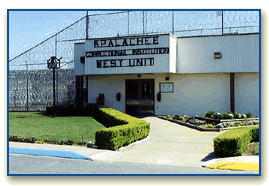
Apalachee Correctional Institution West Unit
State Prison | Jackson County — Florida | ACIWU | Florida Department of Corrections | FL DOC
Apalachee Correctional Institution West Unit is a male state correctional facility located at 52 West Unit Drive in Sneads, Jackson County, Florida. Operated by the Florida Department of Corrections (FDC), the West Unit houses adult male inmates across a broad spectrum of security classifications — from community custody through close custody — making it one of the more versatile and operationally flexible facilities in Florida's panhandle region. With a current population of 817 inmates and a design capacity of 819, the facility operates at near-full capacity under the leadership of Warden John A. Barfield.
Established in 1959, the West Unit has served Florida's correctional system for more than six decades, adapting continuously to meet evolving standards in inmate management, rehabilitation, and public safety. Its location in rural Jackson County places it within a broader network of correctional institutions that dot Florida's northern panhandle, and it remains one of the region's most significant employers and state-operated facilities. The West Unit is one of many institutions listed among Florida correctional facilities maintained by the FDC.
Families with loved ones incarcerated here can access inmate records through the Florida Department of Corrections' official online database. If you are trying to locate someone and are unsure of their current placement, you can search criminal records to find current incarceration status and additional background details. Approved visitors may schedule in-person visits, loved ones can send funds to inmate commissary accounts, and correspondence by mail is permitted under FDC guidelines.
What sets Apalachee Correctional Institution West Unit apart from many single-classification facilities in Florida is its multi-custody level classification model, which allows the institution to house inmates ranging from community custody — the least restrictive classification in Florida's system — all the way through close custody, one step below maximum security. This broad classification range is relatively uncommon among Florida state prisons of comparable size, and it gives the West Unit a degree of operational flexibility that benefits both the correctional system and the inmates housed there.
In practical terms, this means that an individual's experience at the West Unit can vary considerably depending on their assigned custody level. A community custody inmate may participate in work release programs, have broader movement privileges within the facility, and access a wider range of programming. A close custody inmate, by contrast, will face more structured daily routines, tighter movement controls, and heightened supervision — though they still have access to core rehabilitative services such as education and substance abuse treatment.
This classification versatility also allows the Florida Department of Corrections to transfer inmates between custody levels without necessarily moving them to an entirely different facility, which can be a meaningful benefit for families who live in the panhandle region and rely on geographic proximity for regular visitation. Additionally, the multi-level model creates a built-in incentive structure: inmates who demonstrate positive behavior and program participation can work toward a less restrictive custody classification without leaving the institution, providing continuity in programming and family contact throughout their sentence.
Apalachee Correctional Institution West Unit currently houses 817 adult male inmates across four primary custody classifications: community custody, minimum custody, medium custody, and close custody. Operating at approximately 99.8% of its 819-person design capacity, the facility reflects the broader reality of Florida's correctional system, which consistently manages one of the largest incarcerated populations in the United States.
The inmate population at the West Unit is diverse in terms of age, offense type, sentence length, and rehabilitative need. Because the facility accepts inmates across such a wide custody spectrum, the population at any given time includes individuals serving relatively short sentences for nonviolent offenses alongside those serving lengthy terms for serious violent crimes. This cross-section requires the facility's staff and programming teams to tailor their approaches to a wide range of risk levels and individual needs.
Demographically, the West Unit's population mirrors statewide trends in Florida's prison system, which — like most state systems — disproportionately incarcerates men of color, individuals with histories of substance abuse, and those with limited formal education or vocational skills. The facility's programming offerings are designed in part to address these underlying factors. Inmates are assessed upon arrival using validated risk-and-needs tools, and program placements are informed by those assessments to maximize the likelihood of successful reintegration upon release.
Families seeking information about a specific incarcerated individual can use the Florida Department of Corrections' official inmate search tool to verify current housing placement, projected release date, and other public record details.
Living conditions at Apalachee Correctional Institution West Unit are structured according to each inmate's custody classification, with housing type, daily schedule, movement privileges, and access to amenities all calibrated to security level. This tiered approach is standard across Florida Department of Corrections facilities and reflects a philosophy of graduated freedom tied to demonstrated behavior and assessed risk.
Close custody inmates reside in more controlled, cell-based housing units with limited movement outside of scheduled activities. Their daily routines are tightly structured, with designated times for meals, recreation, programming, and personal time. Lower custody inmates — those classified at the medium, minimum, or community levels — are generally housed in open dormitory-style units featuring multiple bunk assignments and somewhat greater freedom of movement within designated facility areas. Dormitory housing is typically arranged in large bay-style rooms with shared bathroom and shower facilities.
All inmates receive three meals per day prepared and served by the facility's food service operation, which operates in compliance with FDC nutritional standards. Medical and mental health care is provided on-site, with referrals to outside specialists made when the facility's resources are insufficient to address an inmate's needs. Dental care and vision services are also available, though scheduling may involve waiting periods consistent with a facility of this size.
Each inmate is provided basic clothing, bedding, and hygiene items, with access to the commissary for supplemental goods. Recreation includes access to outdoor yards and, depending on custody level, participation in organized sports, fitness equipment, and leisure activities. The facility maintains a law library that inmates may access to support legal research and correspondence related to their cases.
Apalachee Correctional Institution West Unit provides a range of rehabilitative programming designed to address the root causes of criminal behavior, build practical life skills, and reduce the likelihood of reoffending after release. The Florida Department of Corrections emphasizes evidence-based program delivery across its institutions, and the West Unit's offerings reflect that statewide commitment to meaningful rehabilitation alongside secure custody.
Educational programs form a cornerstone of the facility's rehabilitation efforts. Inmates who have not earned a high school diploma or its equivalent can enroll in adult basic education (ABE) courses or work toward a GED credential through on-site instruction. Florida law mandates that eligible inmates without a high school diploma participate in educational programming, reinforcing the importance placed on basic literacy and numeracy as foundations for post-release success. For those who have already completed secondary education, postsecondary coursework may be available through partnerships with community colleges or distance learning providers.
Vocational training programs offer inmates the opportunity to develop marketable trade skills before their release. Depending on available resources and enrollment space, these programs may include areas such as building maintenance, custodial services, food service operations, and other fields aligned with regional employment demand. Completion of a vocational certificate can meaningfully improve an inmate's employment prospects upon reentry.
Substance abuse treatment is another critical program area at the West Unit, given that a significant portion of Florida's incarcerated population has documented histories of drug or alcohol dependency. The facility offers structured treatment programming — ranging from educational courses to more intensive therapeutic interventions — aimed at helping inmates understand the relationship between substance use and criminal behavior and develop strategies for sustained recovery.
Additional programming may include life skills courses covering topics such as financial literacy, anger management, parenting, and conflict resolution. Faith-based programming is also available through chaplaincy services and community volunteers, providing spiritual support and structured group activities for interested inmates. Participation in these programs can positively influence an inmate's classification review and parole or early release eligibility under Florida's gain-time system.
Inmates at Apalachee Correctional Institution West Unit participate in various work assignments that support facility operations and provide practical work experience. Inside job assignments include food service, facility maintenance, laundry operations, and janitorial duties that keep the institution functioning daily. Groundskeeping and landscape maintenance crews maintain the facility's exterior areas. Eligible inmates in lower custody classifications may qualify for outside work squads that perform labor for public entities and state properties under supervision. These work assignments teach responsibility, time management, and job skills while reducing idleness. Participation in work programs is typically mandatory for able-bodied inmates and may factor into custody reclassification and disciplinary records.
Apalachee Correctional Institution West Unit was established in 1959, during a significant period of expansion across Florida's correctional infrastructure. As Florida's post-war population grew rapidly through the late 1950s and into the 1960s, state officials recognized an urgent need for additional secure housing capacity, particularly in rural regions where land was available and development costs were manageable. The panhandle community of Sneads, nestled in Jackson County along the Chattahoochee River corridor, offered the geographic isolation, available acreage, and existing road infrastructure that correctional planners sought at the time.
Over its more than six decades of continuous operation, the West Unit has undergone considerable transformation in both physical infrastructure and operational philosophy. The early decades of the facility were marked by a labor-focused correctional model common to Southern prisons of the era, in which inmates participated heavily in agricultural and manual labor programs. Florida, like many Southern states, relied on prison farms and work camps to offset the costs of incarceration, and the West Unit's rural setting made it well suited to that model.
By the 1970s and 1980s, sweeping federal court oversight of state prison systems — including Florida's — prompted significant reforms in how inmates were housed, classified, and treated. The West Unit adapted to these changes, phasing out punitive labor practices and investing in formal educational and vocational programming. The 1990s brought further modernization, including updated physical plant improvements and the adoption of structured risk-and-needs assessment tools that remain central to Florida's classification system today.
In more recent decades, the facility has continued to evolve in response to legislative mandates, budget constraints, and shifting correctional best practices. Today, the West Unit stands as a long-tenured institution with deep roots in Jackson County's history and an ongoing mission to house, manage, and rehabilitate Florida's incarcerated population responsibly.
No widely documented famous former inmates are publicly associated with Apalachee Correctional Institution West Unit at this time. The facility's population has historically consisted primarily of adult males serving sentences for a broad range of offenses under Florida law, without notable public figures drawing widespread media attention to this specific unit. If you are researching the background of a specific individual who may have been incarcerated at this or another Florida facility, you can search public criminal records to access available background information, incarceration history, and other public record details.
Maintaining regular contact with an incarcerated family member is one of the most important factors in supporting both their well-being during incarceration and their successful reintegration after release. Research consistently shows that inmates who maintain strong family connections are less likely to reoffend, and the Florida Department of Corrections recognizes visitation as a key component of its rehabilitative mission. Apalachee Correctional Institution West Unit facilitates in-person visitation in accordance with Florida Department of Corrections visitation policies, which apply uniformly across state facilities with some facility-specific scheduling considerations.
Before visiting, all prospective visitors must complete an approval process through the Florida Department of Corrections. This involves submitting a visitor application, undergoing a background check, and receiving written approval before any visit can take place. The approval process is designed to maintain facility security while still supporting family contact, and it typically takes several weeks to complete. Visitors who arrive without prior approval will not be admitted. Families are strongly encouraged to begin the approval process as early as possible after a loved one's incarceration.
Approved visitation typically takes place on weekends and designated holidays, though specific days and hours are subject to change based on facility schedules, staffing availability, and any lockdown or emergency conditions. Visitors should always confirm current visitation hours directly with the facility before making travel arrangements. Dress code requirements are strictly enforced — clothing that resembles inmate attire, is revealing, or displays inappropriate imagery will result in denial of entry.
Visitors are expected to bring a valid government-issued photo ID, and minors must be accompanied by an approved adult guardian. Items brought into the facility are strictly limited; most personal belongings must be secured in a vehicle or facility locker before entering the visitation area. For full details on approved items, scheduling procedures, and visitor conduct expectations, families can review the official Florida DOC visitation guidelines. In addition to in-person visits, families can also send money to an inmate's commissary account to help cover the cost of personal items, phone calls, and supplemental food.
Staying in contact with an incarcerated loved one at Apalachee Correctional Institution West Unit is possible through several approved communication channels, including postal mail, telephone, and where available, approved electronic messaging platforms. Each method is subject to monitoring and logging by facility staff, and both inmates and their families should be aware that all communications — with the exception of properly designated legal mail — may be reviewed.
Postal mail is one of the most reliable and widely used methods for staying in touch. Letters sent to inmates at the West Unit should be addressed to the inmate using their full legal name and Florida Department of Corrections inmate identification number, with the facility's mailing address at 52 West Unit Drive, Sneads, FL 32460. All incoming mail is inspected for contraband before delivery. Envelopes should be plain white, and letters should be written on standard paper. Cards and photographs may be permitted under certain guidelines — contact the facility directly to confirm current rules before sending non-standard items.
Telephone calls are another primary form of contact, though all calls placed from inmate phones are made at the inmate's expense using a prepaid account system managed by the FDC's contracted phone service provider. Family members do not typically need to register in order to receive calls, but setting up a prepaid account through the provider's website can help reduce costs. Calls are recorded and monitored except those designated as privileged legal communications.
Electronic messaging may be available through the FDC's approved digital communication platform, allowing families to send and receive messages similar to email. This service typically requires account creation and a per-message fee. Video visitation may also be offered as a supplement — though not a replacement — to in-person visits, depending on facility resources and current FDC policy.
If you are unsure whether a loved one is housed at this facility or need help navigating the inmate location process, our guide on how to find an inmate provides step-by-step instructions for searching Florida's correctional system. You can also look up an inmate's arrest history and incarceration details using publicly available records tools.
Sponsored and Powered by our Partner TruthFinder
Quick Facts
Should I Be Concerned? — Family Guide
Apalachee Correctional Institution West Unit maintains an exceptional safety record with zero reported staff assaults, making it one of Florida's safest correctional facilities for both inmates and visitors. The facility's community-close security designation reflects careful inmate classification and robust operational protocols refined over six decades of continuous operation. Families can visit with confidence knowing the institution prioritizes a secure, stable environment.
The lower-risk inmate population and enhanced family visitation privileges create an atmosphere conducive to rehabilitation and meaningful family connections. Staff training and established protocols ensure visitors experience professional, orderly operations that support positive family interactions essential to inmate reentry success.
Neighborhood & Getting There
Apalachee Correctional Institution West Unit is located in Sneads, a quiet rural community in Jackson County in Florida's Panhandle, approximately 90 miles northwest of Tallahassee and 30 miles south of the Georgia border. The peaceful agricultural setting provides a calm environment away from urban congestion, though visitors should note that commercial services and accommodations are limited in the immediate area.
For overnight stays, visitors typically find lodging options in nearby Marianna (approximately 20 miles away) and Tallahassee (90 miles), which offer hotels, restaurants, and services. The drive to Apalachee West Unit is scenic but rural—plan accordingly with a full tank of gas and supplies, as amenities become sparse the closer you get to Sneads. GPS navigation is strongly recommended for first-time visitors navigating the rural roads of Jackson County.